Your business has assets to sell.
Maybe you're closing a location. Retiring. Relocating. Downsizing. Clearing excess inventory. Replacing equipment. Or preparing an entire facility for its next chapter.
Now comes the big question:
How do you sell everything?
You could take the traditional route and sell assets individually at fixed asking prices. Or you could organize those assets into an online business liquidation auction and let buyers compete for them.
Both approaches can sell business property.
But when you're dealing with equipment, machinery, tools, fixtures, inventory or an entire facility, the experience can look very different.
Here's what business owners should know.
What do we mean by a traditional sale?
For this article, a traditional sale means selling business assets individually through fixed-price listings, direct negotiations, classified marketplaces or other one-to-one transactions.
You determine an asking price.
A potential buyer contacts you.
You answer questions.
They may negotiate.
You arrange payment.
Then you coordinate pickup.
For a few assets, that can be perfectly manageable.
But imagine doing it with 200.
That's when the math changes.
What is a business liquidation auction?
A business liquidation auction takes a more structured approach.
Instead of individually negotiating the sale of each asset, items are organized into an auction where buyers have a defined period of time to place bids.
At Equip-Bid, our outside sales team specializes in helping businesses manage this process.
Depending on the project, that can include:
- A pre-sale walkthrough
- Identifying and organizing assets
- On-site photography and tagging
- Creating item descriptions
- Building the online auction
- Marketing the sale
- Reaching targeted buyers
- Managing bidding
- Collecting bidder payments
- Coordinating removal
- Settling with the seller
The goal isn't simply to put your assets online.
It's to create a plan for getting them sold and removed while reducing the workload on your business.
The biggest difference: one transaction at a time vs. one organized sale
Suppose you're selling one skid steer.
Creating a listing, answering a few calls and negotiating with buyers might not be a big deal.
Now suppose you're selling:
Three skid steers.
Two trailers.
A shop full of tools.
Office furniture.
Warehouse shelving.
Attachments.
Vehicles.
Parts.
And everything else that has accumulated over 30 years in business.
Selling each asset individually means repeating essentially the same process over and over again.
A liquidation auction organizes those assets into a larger event.
That distinction becomes increasingly important as the number of assets grows.
Traditional sales put pricing on the seller
With a traditional sale, one of your first jobs is deciding:
What's everything worth?
That's easier with some assets than others.
You may have a good idea what a vehicle is worth.
But what about specialized machinery?
Used restaurant equipment?
A warehouse full of racking?
An older attachment?
A piece of equipment with relatively few comparable listings?
You can research asking prices, but an asking price doesn't necessarily tell you what someone is actually willing to pay.
Then you have another decision.
Do you price high and leave room to negotiate?
Price aggressively to move it quickly?
Reduce the price if nobody calls?
Every asset becomes another pricing decision.
Auctions let bidders compete
A business liquidation auction approaches pricing differently.
Instead of relying solely on a predetermined asking price, interested buyers bid against one another.
The market helps determine the hammer price.
That doesn't guarantee a specific return, and not every item will attract the same amount of competition.
But when multiple bidders want the same asset, the auction format gives them an opportunity to compete for it.
For a business with a wide range of assets, that can simplify the question of individually pricing and negotiating every piece.
Traditional sales require you to find your own customers
You can have great equipment at a reasonable price.
It doesn't matter much if the right buyers never see it.
With a traditional sale, the seller is often responsible for deciding where to advertise and how to reach potential buyers.
That can be relatively straightforward for common assets.
Specialized commercial equipment can be different.
The person who needs your exact piece of machinery might not live in your town.
They might not even live in your state.
That's where the audience behind an online auction becomes important.
A liquidation auction can reach beyond your local market
Equip-Bid can market business liquidations to its existing bidder audience and build additional targeted marketing around the assets being sold.
Depending on the liquidation, that may include email marketing, social media, digital advertising, Google Ads, auction referral sites and campaigns aimed at bidders interested in particular equipment categories. Those marketing channels are part of Equip-Bid's broader auction sales approach.
That's particularly valuable for specialized assets.
A restaurant owner understands commercial kitchen equipment.
A contractor understands construction machinery.
A farmer recognizes a particular attachment.
An industrial bidder may know exactly what they're looking at when everyone else scrolls past it.
The objective isn't simply to get more people to see an auction.
It's to help the right bidder find it.
Traditional sales can offer more control over timing
There are situations where selling individually makes sense.
If you have only a few assets and no particular deadline, you may be willing to wait.
List an item.
Set your price.
See what happens.
If it doesn't sell this week, maybe it sells next month.
That flexibility can be useful.
Business liquidations often have a different priority:
There is a deadline.
The lease ends.
The property has sold.
The owner is retiring.
A location is closing.
New equipment is coming in.
The building needs to be empty.
In those situations, waiting indefinitely for individual buyers may not fit the business's timeline.
Online auctions create a defined process
One of the primary goals in Equip-Bid's business liquidation approach is to work within the seller's allowed timeframe.
Instead of listing assets with no defined ending, an auction establishes a schedule.
The assets are cataloged.
The auction goes live.
Marketing runs.
Bidding closes.
Bidders pay.
Removal takes place.
The seller is settled according to the agreed process.
The exact timeline depends on the size and complexity of the liquidation, but the structure gives the project a destination.
For a business that needs to move forward, that matters.
What about the work involved?
This may be the biggest difference for the business owner.
With a traditional sale, your company may be responsible for much of the work.
Someone has to:
Take photos.
Create listings.
Research prices.
Answer emails.
Answer phone calls.
Negotiate.
Meet buyers.
Collect payments.
Coordinate pickup.
Keep track of what's sold.
Follow up when somebody doesn't show.
Repeat.
If you're selling a handful of assets, maybe that's worth it.
If you're liquidating a facility, you're essentially asking someone on your team to take on another job.
A full-service liquidation shifts much of that workload
Equip-Bid's outside sales team specializes in business liquidations, and the process is designed to reduce the amount of work required from the seller.
For larger projects, our team can perform a pre-sale walkthrough and come on-site to photograph, tag and describe equipment.
From there, Equip-Bid can build and market the auction, manage bidding and collect payment from winning bidders before assets are released.
That's why one of the stated objectives of Equip-Bid's liquidation approach is to simplify the selling process and reduce seller labor during the auction.
Your employees have a business to run, close, move or transition.
They shouldn't necessarily have to become an auction team too.
Removal is another major difference
Selling something is one thing.
Getting it out of the building is another.
With individual sales, removal may happen one buyer at a time.
Tuesday at 4:30.
Saturday morning.
Next Wednesday.
"Can you hold it until the 15th?"
Multiply that across dozens of buyers and the facility can remain tied up in pickups for quite a while.
A liquidation auction can consolidate removal into a planned process.
For Equip-Bid business liquidations, bidders can be responsible for breaking down and removing their purchases during the designated removal period, reducing labor for the seller.
The exact removal plan will depend on the project and auction terms.
But the objective is clear:
Get sold assets out so the business can move forward.
What about payment?
Traditional private sales can also mean managing payment yourself.
Cash?
Check?
Wire?
Did it clear?
Who has paid?
Who still owes you?
With an Equip-Bid liquidation, bidder payment can be handled as part of the auction process, with payment collected before equipment leaves the property.
Winning bidders pay the hammer price plus the buyer's premium, a $1.50 item fee per item, and any applicable sales tax. The item fee is charged to the bidder, not the seller.
For a large liquidation involving many bidders, having one structured payment process can remove another administrative burden from the seller.
Which approach can produce a better return?
There's no responsible way to say that one method will always produce more money.
Too many factors affect an asset's selling price.
Condition matters.
On Equip-Bid, sellers can list items with one of five condition labels: Factory Sealed, Appears New, Open Box, Damaged or Partial/Incomplete. Bidders can also inspect items in person when the auction offers an inspection time.
Demand matters.
Marketing matters.
The asset itself matters.
The number of interested buyers matters.
Timing matters.
A traditional fixed-price sale gives you control over the asking price, but you may need to wait for someone willing to meet it.
An auction gives bidders the opportunity to compete, but the market ultimately determines how much competition exists.
That's why Equip-Bid's liquidation strategy isn't built around promising a particular selling price.
The goal is to create the conditions for a strong sale by maximizing exposure and opportunity while simplifying the process for the seller.
When does a traditional sale make sense?
Selling assets individually may make sense when:
- You only have a few things to sell
- You know exactly what you want for them
- You already have potential buyers
- You're comfortable negotiating
- You don't mind managing transactions yourself
- There's no urgency
- You can wait for the right offer
Not every asset sale needs to become an auction.
The scale and circumstances matter.
When does a business liquidation auction make sense?
An online liquidation becomes particularly worth considering when:
- You're selling a large number of assets
- A business or location is closing
- An owner is retiring
- You're relocating
- You're downsizing
- You need to reduce inventory
- You're selling specialized equipment
- You need broader bidder exposure
- There's a deadline for clearing the property
- Your employees don't have time to manage individual sales
- You want one organized process for listing, marketing, payment and removal
Equip-Bid's auction experience includes business liquidations, heavy equipment, inventory reduction, overstock, wholesale, retail and industrial assets.
Those are exactly the kinds of situations where scale can turn a simple sale into a project.
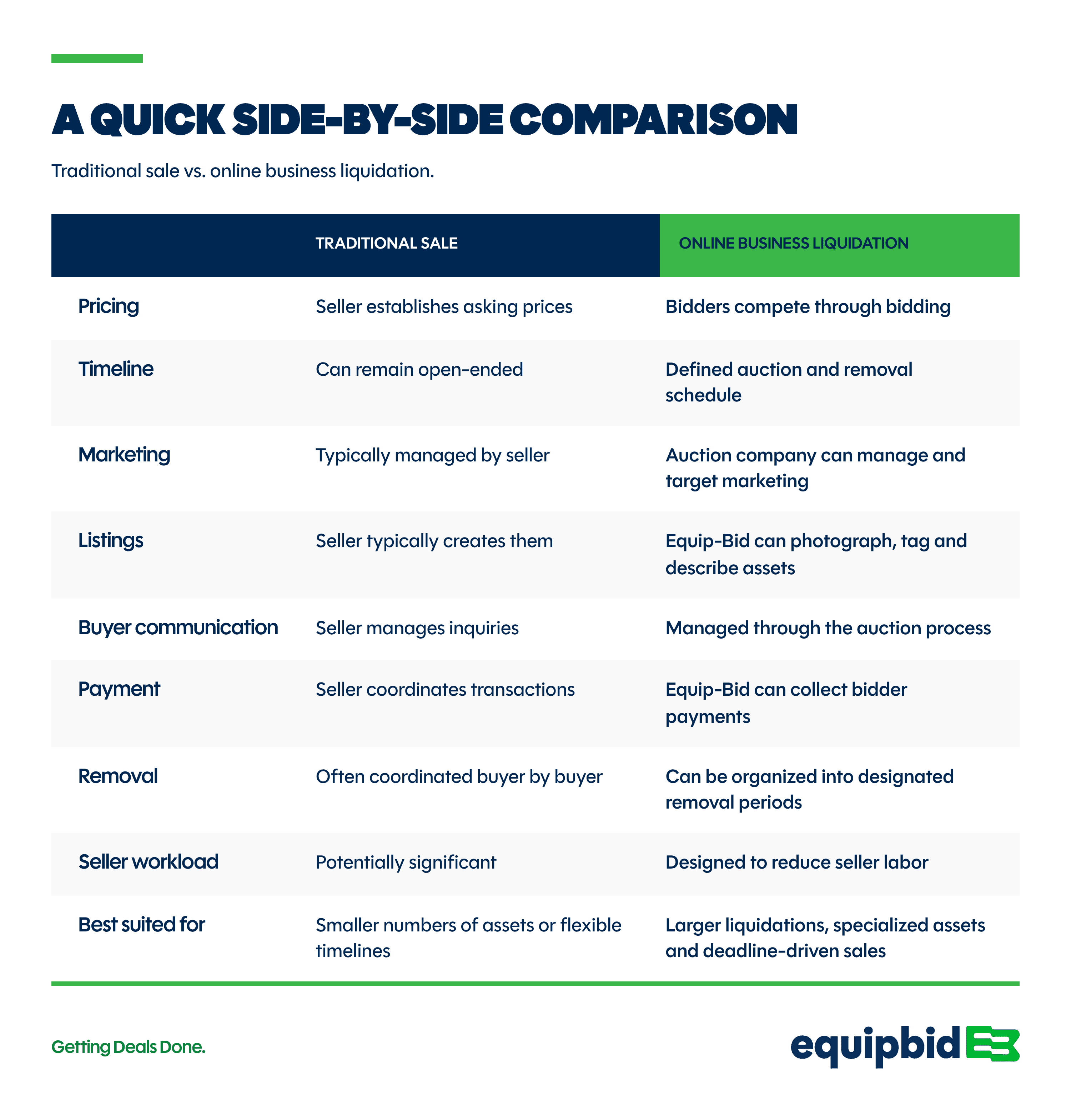
The question isn't just "How do we sell this?"
When businesses first start thinking about liquidation, the conversation naturally focuses on price.
What can we get for everything?
That's important.
But it isn't the only cost in the equation.
There's also the time your employees spend selling.
The space occupied by unused assets.
The cost of delaying a move.
The work involved in coordinating buyers.
The deadline for clearing the facility.
The distraction from whatever your company needs to do next.
That's why the better question may be:
"What's the best way to get this entire project done?"
When it's more than a sale, build a liquidation plan
Selling a few assets and liquidating a business aren't necessarily the same job.
When you're dealing with an entire operation, Equip-Bid's outside sales team can help build a plan around the assets, the bidders and your timeline.
Walk the facility.
Identify what needs to move.
Catalog the assets.
Build the auction.
Market it.
Get bidders bidding.
Collect payment.
Coordinate removal.
Get the building cleared.
Then let your business focus on whatever comes next.
That's the difference between listing things for sale and managing a liquidation.